Do You Need to Stretch More? How Strength Training Can Improve Mobility
Oct 15, 2026
by Gregg Piper
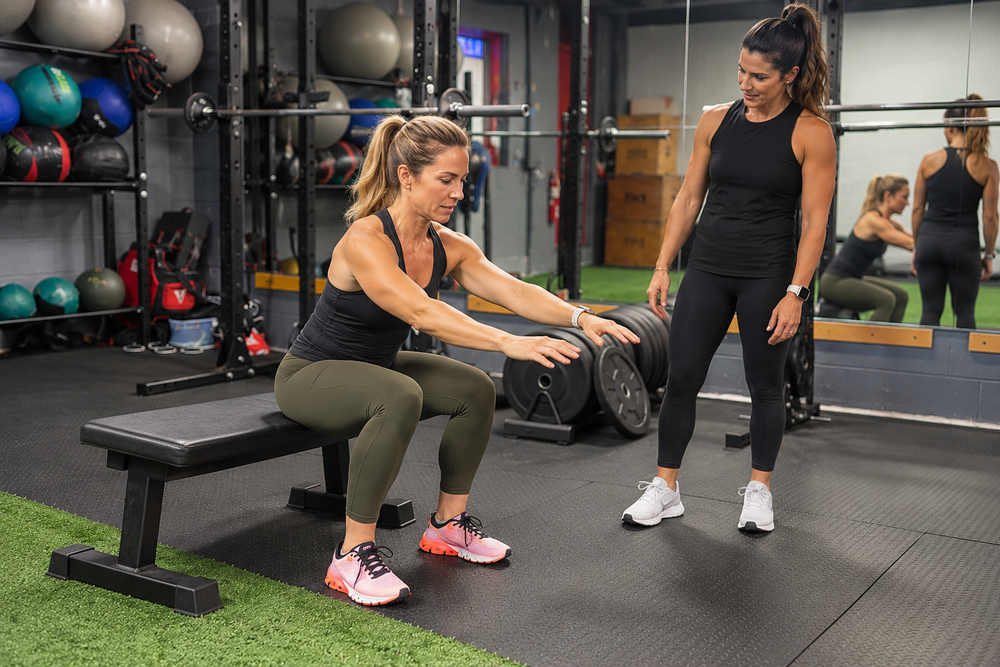
If your hips feel stiff after sitting at work or reaching overhead feels harder than it used to, your first thought may be simple:
I need to stretch more.
Stretching can absolutely improve flexibility. But it is not the only tool available.
Research increasingly suggests that resistance training performed through appropriate ranges of motion can also improve joint range of motion. In other words, becoming stronger and becoming more mobile do not have to be separate goals.
For many adults, a practical approach is not choosing between strength and mobility. It is learning to build strength through the ranges of motion their body can comfortably control.
Mobility and Flexibility Are Related, but Not Identical
People often use "mobility" and "flexibility" interchangeably.
For everyday fitness purposes, it can help to think about them slightly differently.
Flexibility generally describes the available range of motion around a joint.
Mobility is often used in fitness settings to describe your ability to move through useful ranges of motion with control.
Imagine that you can pull your knee toward your chest while lying down. That demonstrates available motion.
Now imagine stepping onto a box, controlling the movement, and standing tall without losing balance.
That requires you to use movement actively.
This distinction matters because most people do not simply want to become more flexible. They want their bodies to work better during exercise and everyday life.
Can Strength Training Really Improve Flexibility? 🏋️
Yes, under the right conditions.
A 2023 systematic review and meta-analysis examining 55 studies found that resistance training improved range of motion in healthy participants. The researchers found no significant difference between resistance training and stretching for improving range of motion overall.
A separate 2021 systematic review comparing strength training directly with stretching also found no significant difference in range of motion improvements, although the authors noted substantial differences among the included studies.
More recently, a 2025 systematic review and meta-analysis involving 36 studies and 1,469 healthy adults also concluded that resistance training can improve joint flexibility. However, the researchers emphasized that study heterogeneity and overall risk of bias limit how definitive those conclusions can be.
The practical takeaway is not that stretching has become unnecessary.
It is that strength training can be part of your mobility strategy instead of automatically being viewed as something that makes you stiff.
Why Range of Motion During Strength Training Matters
How you perform an exercise matters.
Consider a squat.
One person may descend only a few inches because that is the deepest position they can currently control.
Another person may comfortably squat much deeper while maintaining a stable position.
The goal should not be forcing both people into exactly the same depth.
Instead, each person can work through an appropriate range and gradually develop more strength and control.
Research comparing full and partial range resistance training has generally found advantages to training through fuller ranges when those ranges can be performed appropriately. A 2021 systematic review and meta-analysis found greater strength adaptations with full range training than partial range training, with particularly favorable findings for lower body muscle growth.
That does not mean "deeper is always better."
Pain, injury history, individual anatomy, technique, and exercise selection still matter.
It means unnecessarily shortening every movement may leave useful opportunities for strength and movement development on the table.
What This Looks Like in Real Life
You do not need exotic mobility drills to apply this concept.
Common strength exercises already require meaningful movement at multiple joints.
For example:
A controlled squat trains the hips, knees, and ankles.
A split squat challenges hip and ankle movement while requiring balance and leg strength.
A properly selected row trains the upper back while the shoulder moves under control.
A step-up combines hip and knee motion with balance and strength.
A loaded carry challenges posture, grip, trunk control, and walking mechanics.
V3 Fit Club’s Group Fitness Classes currently include strength training and functional movements such as squats, carries, deadlifts, pull-ups, band exercises, and core work. Exercises are also intended to accommodate different fitness levels.
That makes movement quality particularly important.
The objective is not simply to finish repetitions. It is to perform movements with a range and resistance you can control.
Stretching vs. Strength Training: What Should You Use?
You do not necessarily need to choose.
| If your goal is... | A useful approach |
|---|---|
| Relaxing and moving after prolonged sitting | Gentle movement or stretching may feel appropriate |
| Improving passive range of motion | Stretching can be useful |
| Becoming stronger through a larger usable range | Resistance training through appropriate ranges can help |
| Preparing for a strength workout | Movement-specific warm-up exercises can prepare you for the session |
| Improving overall fitness | Combine appropriate strength, aerobic activity, and mobility work based on your needs |
| Addressing persistent pain or a clinical limitation | Seek assessment from an appropriate healthcare professional |
The Physical Activity Guidelines for Americans recognize flexibility activities as an appropriate component of physical activity programs, while noting that flexibility work by itself does not count toward the aerobic or muscle strengthening recommendations.
The CDC currently recommends that adults get at least 150 minutes of moderate-intensity aerobic activity per week and perform muscle strengthening activities involving the major muscle groups on at least two days each week.
You can therefore think of mobility work as supporting your broader activity plan rather than replacing strength or aerobic exercise.
A Practical Five Minute Movement Check 🔎
You do not need to diagnose your own mobility restrictions.
But you can pay attention to how common movements feel.
Before a workout, ask yourself:
1. Can I sit down and stand up comfortably?
Use a stable chair or bench.
Notice whether the movement feels controlled and relatively symmetrical.
2. Can I raise my arms overhead comfortably?
Do not force the movement.
Simply notice whether one side feels noticeably different or whether discomfort appears.
3. Can I perform a controlled split stance?
Place one foot in front of the other and gently bend both knees within a comfortable range.
Notice your balance and control.
4. Can I hinge at my hips without discomfort?
Think about pushing your hips backward rather than simply bending forward through your spine.
5. Is there pain?
This is the most important question.
Feeling stiff is not the same as experiencing persistent or sharp pain.
If a movement causes significant pain, repeatedly forcing yourself farther is not a sensible mobility strategy.
This check is not a medical assessment. It simply gives you information that can be useful when discussing exercise selection with a coach.
Three Mobility Mistakes to Avoid
Mistake 1: Assuming every tight feeling needs aggressive stretching
A sensation of stiffness does not automatically tell you why a movement is limited.
Trying to force a joint farther without understanding the situation may not solve the underlying problem.
Sometimes a better starting point is controlled movement with an appropriate exercise and resistance.
Mistake 2: Treating mobility as a separate 30-minute project
If a long mobility routine means you never do it, simplify.
Mobility can be incorporated into your warm-up and strength training.
For example, you might use a controlled bodyweight squat during your warm-up and then train the squat pattern with appropriate resistance during the workout.
Mistake 3: Chasing someone else's range of motion
Your squat does not need to look identical to the person next to you.
Bodies differ.
Training history differs.
Goals differ.
The useful question is whether your movement is becoming more comfortable, controlled, and capable over time.
What About Adults Who Feel Stiffer With Age? 🚶
It is common for adults to notice changes in movement as activity patterns change over time.
Long workdays, less recreational movement, and fewer opportunities to move through varied positions can all influence how active you feel.
The solution does not have to be an extreme flexibility program.
A more realistic strategy might include walking regularly, strength training multiple times each week, moving during long periods of sitting, and using targeted mobility exercises where they are genuinely useful.
For adults 65 and older, current CDC guidance also includes balance activities in addition to aerobic and muscle strengthening exercise.
The larger principle is simple:
Keep giving your body opportunities to move.
How Coaching Can Help
Knowing that an exercise is "good for mobility" is less useful than knowing whether that exercise is appropriate for you.
A coach can observe how you move, adjust the exercise, modify the range, change the resistance, or select another variation.
V3 Fit Club currently offers One-on-One Personal Training, where workouts are customized around an individual's goals, fitness level, abilities, and schedule.
Its Semi-Private Personal Training also uses individualized workout plans while members train in small groups of 2 to 4 people.
For someone who feels unsure about exercise technique or how far they should move, that individualization can be useful.
Coaching is not a substitute for medical evaluation, however.
If you have significant pain, a recent injury, surgery, a neurological condition, or another medical issue affecting movement, speak with an appropriate healthcare professional about exercise before attempting to solve the issue through stretching or training alone.
A Simple Weekly Approach
For a generally healthy adult, mobility does not have to dominate the fitness calendar.
A hypothetical week might look like this:
Monday: Full body strength training, using comfortable and controlled ranges
Tuesday: Walking plus a few minutes of mobility for areas that feel stiff
Wednesday: Strength or group fitness
Thursday: Light activity and normal everyday movement
Friday: Full body strength training
Saturday: Recreational activity, walking, cycling, or another activity you enjoy
Sunday: Recovery and optional gentle mobility work
This is only an example, not an individualized prescription.
The key is that mobility does not live in isolation. It can develop alongside strength, conditioning, balance, and everyday physical activity.
Frequently Asked Questions
Does lifting weights make you less flexible?
Not necessarily. Systematic reviews have found that resistance training can improve range of motion, particularly when exercises use meaningful ranges of motion.
Is stretching still worth doing?
Yes. Stretching is effective for improving flexibility and may be useful when a particular range of motion matters to you. The evidence that strength training can improve range of motion does not make stretching useless.
Should I stretch before lifting weights?
You do not necessarily need a long static stretching routine before every strength session. A movement-specific warm-up that gradually prepares you for the exercises you will perform can be practical. Individual needs vary.
How long does it take to improve mobility?
There is no universal timeline. The answer depends on your starting point, the joint and movement involved, your training approach, consistency, and whether pain or a medical issue is contributing to the limitation.
What if stretching or strength exercises hurt?
Do not repeatedly force a painful movement. Persistent or significant pain warrants evaluation by an appropriate healthcare professional.
Build Strength You Can Actually Use
Mobility does not have to mean spending an hour stretching on the floor.
And strength training does not have to mean becoming stiff.
A well-designed program can help you develop strength through useful, controlled ranges of motion while improving the physical capabilities you rely on outside the gym.
If you are in Highland Park and want help choosing exercises and progressions that match your current abilities, explore V3 Fit Club Personal Training or V3 Fit Club Semi-Private Personal Training to learn how individualized coaching fits into V3's approach.
